
Overview
ISO Certification is an internationally recognized standard that helps organizations improve quality, efficiency, safety, and customer satisfaction. ISO standards are developed by the International Organization for Standardization (ISO) and are applicable to businesses across industries, including manufacturing, services, healthcare, IT, education, and more.
ISO certification demonstrates a company’s commitment to quality management and continuous improvement. At Adviso Compliance, we provide complete ISO certification services, including gap analysis, documentation, certification audits, and ongoing compliance support.
What is ISO Certification?
ISO certification is a formal recognition that an organization’s management system, process, or service meets international standards. Certification is granted by accredited certification bodies after a detailed audit of business processes and documentation.
ISO certification helps businesses standardize operations, reduce errors, and build trust with customers, partners, and regulators.
Why ISO Certification is Important
ISO certification offers multiple operational and commercial benefits:
Improves product and service quality
Enhances customer satisfaction
Increases operational efficiency
Reduces risks and errors
Improves brand credibility and trust
Helps win tenders and contracts
Supports international business expansion
ISO-certified organizations are often preferred by clients and government bodies.
Types of ISO Certifications
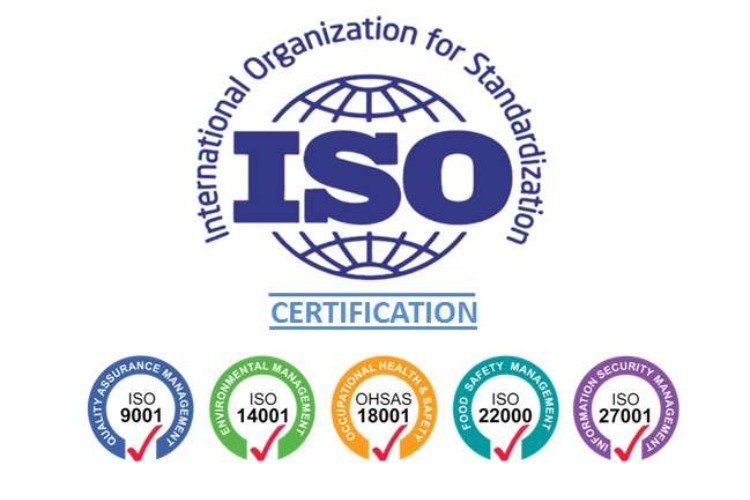
There are several ISO standards applicable to different industries and requirements. Some commonly used ISO certifications include:
ISO 9001 – Quality Management System
Focuses on consistent quality, customer satisfaction, and process improvement.
ISO 14001 – Environmental Management System
Helps organizations reduce environmental impact and comply with environmental regulations.
ISO 45001 – Occupational Health & Safety
Ensures a safe and healthy workplace by reducing workplace hazards.
ISO 22000 – Food Safety Management System
Applicable to food businesses to ensure food safety across the supply chain.
ISO 27001 – Information Security Management
Ensures protection of sensitive data and information security controls.
ISO 13485 – Medical Devices Quality Management
Specifically designed for medical device manufacturers.
Choosing the correct ISO standard depends on your business type and objectives.
Who Should Get ISO Certification?
ISO certification is suitable for:
Manufacturing companies
Service providers
IT and software companies
Hospitals and healthcare institutions
Educational institutions
Food processing units
Startups and MSMEs
Government contractors
Any organization looking to improve processes and credibility can apply for ISO certification.
Documents Required for ISO Certification
The documents required may vary based on the ISO standard, but generally include:
Business registration certificate
Scope of certification
Quality or management policy
Process flow and SOPs
Risk assessment documents
Internal audit records
Management review records
Our experts assist in preparing and reviewing all required documentation.
ISO Certification Process
At Adviso Compliance, we follow a structured and transparent process:
Step 1: Gap Analysis
We assess your current processes against ISO requirements.
Step 2: Documentation Preparation
Policies, procedures, and records are prepared as per ISO standards.
Step 3: Implementation Support
We guide your team in implementing ISO-compliant processes.
Step 4: Internal Audit
Internal audit is conducted to check readiness for certification.
Step 5: Certification Audit
An accredited certification body conducts the final audit.
Step 6: ISO Certificate Issuance
Upon successful audit, the ISO certificate is issued.
Validity & Renewal of ISO Certification
ISO certificates are generally valid for 3 years
Surveillance audits are conducted annually
Renewal audit is required before expiry
We provide ongoing support for surveillance audits and renewal.
ISO Certification for MSMEs & Startups
ISO certification helps MSMEs and startups by:
Improving operational discipline
Enhancing market reputation
Increasing chances of winning tenders
Building customer confidence
ISO certification also supports business scalability.
Common Mistakes in ISO Certification
Businesses often face delays due to:
Incomplete documentation
Poor process implementation
Lack of internal audits
Selecting wrong certification scope
With Adviso Compliance, these issues are avoided through expert guidance.
Why Choose Adviso Compliance for ISO Certification?
Experienced ISO consultants
End-to-end certification support
Accurate documentation and audits
Coordination with accredited certification bodies
Fast processing
Transparent pricing
PAN-India service support
We support you beyond certification with continuous compliance assistance.
Post-ISO Certification Compliance
After certification, organizations must:
Maintain documented processes
Conduct internal audits annually
Undergo surveillance audits
Continuously improve systems
Our team ensures long-term ISO compliance.
FAQs – ISO Certification
ISO certification is not mandatory but highly recommended for quality assurance and credibility.
The process usually takes 2–6 weeks, depending on business size and readiness.
Costs depend on the ISO standard, business size, and certification body.
Yes, ISO certification is suitable for small businesses and startups.
Yes, ISO certification is internationally recognized.